
The IMF has said the fall in inflation rate and slowdown in credit growth were positive signs but the RBI must remain vigilant to prevent overheating of the India economy.

Rajapaksa said China indicated that it would help Sri Lanka, while adding that "usually they don't like" lending out more money to cover earlier debt payments.
"Growth is expected to moderate gradually in China... pick up in India, and remain broadly stable in the Asean-5 region."

Moody's Investors Service on Thursday said India is likely continue to face challenges in raising longer-term growth potential and creating enough jobs for its young population in the absence of higher trade openness. In its report on South Asia sovereigns, Moody's said compared with other South Asian economies, India appears to be in a better position to deepen its integration in global value chains, attract FDI and increase exports. The country has better macroeconomic fundamentals, more stable politics and a more developed export sector.
The World Bank on Tuesday raised the growth forecast for the Indian economy to 7 per cent for the current fiscal year on the back of recovery in agri sector and rural demand. World Bank had in June projected India to grow at 6.6 per cent for FY24. According to the World Bank Report released on Tuesday, India's growth continues to be strong despite a challenging global environment.

Supported by slightly stronger global growth, improving export competitiveness and implementation of recently approved investment projects, India's growth is expected to recover from 4.4 per cent in 2013 to 5.4 per cent in 2014, the IMF said.

Gross non-performing assets of public sector banks surged to 9.32 per cent (Rs 4.76 lakh crore) of advances in 2015-16, from 5.43 per cent (Rs 2.67 lakh crore) in 2014-15.

'If there is a push towards a Marxist oriented government it will be dangerous.' 'We have seen this in Nepal and Myanmar and it will be a concern for India if it is surrounded by countries with such political dispensations.'

Gold, a safe-haven bet, is likely to continue its record-smashing journey in the New Year, rising to Rs 85,000 per 10 grams and even Rs 90,000 level in domestic markets if geopolitical tensions and global economic uncertainties continue.
International Monetary Fund has cut its 2003 global growth forecast to 3.2 per cent from 3.7 per cent due to the Iraq war and stock market declines, and is particularly worried about weak German growth.
If the projections come true, then India would regain the tag of the fastest growing major economy of the world, crossing China with more than 0.7 percentage point in 2018 and an impressive 1.2 percentage point growth lead in 2019.
The avoidable stresses and strains in ties helped in one way. It showed for the entire region how a matured India handled diplomatic relations, especially with a smaller and suspicious neighbour, with practised dignity and patience, unruffled by provocations in word, deed and action, observes N Sathiya Moorthy.
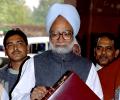
'We are going to need more technical people in government.' 'You can't expect a generalist to understand the complicated world of financial engineering.' 'I regret to say that most of our politicians have no competence to deal with these things. Nor is there a willingness to learn.'
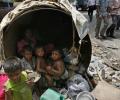
Many factors have been identified as key drivers of the inequality between rural and urban areas in China and India.

A recession is unlikely in the APAC region in the coming year, although the area will face headwinds from higher interest rates and slower global trade growth, Moody's Analytics said on Thursday. In its analysis titled 'APAC Outlook: A Coming Downshift', Moody's said India is headed for slower growth next year more in line with its long-term potential. On the upside, inward investment and productivity gains in technology as well as in agriculture could accelerate growth.

'For the common man, the economic conditions are not going to get better.'

Income inequality could lead to slower economic growth: IMF
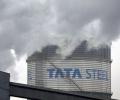
In FY23, Indian operations accounted for 41.6 per cent of the consolidated revenue of India's top five multinationals, up from 34 per cent in FY18 and 33.2 per cent and 34.2 per cent in FY21.

'To the believers of crypto regulations, I have only one question to ask, how will you regulate it?'
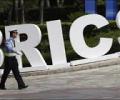
The opening ceremony was held in China's financial capital.

These figures are based on purchasing power parity of 2005.

In his opening remarks at the virtual summit of Leaders of G20 countries, Modi made it clear that terrorism was "unacceptable" to everyone and the death of civilians, anywhere, was condemnable.

'He's charismatic, a populist, very popular, and indeed a cult of personality.' 'That ensures a powerful reaction from his support base -- even if it's not sustained, it will be quite intense, and that's worrisome for stability.'
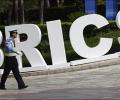
A feature of this year's BRICS summit was economic cooperation.

In advanced economies, growth is strongest in the United States, says IMF.

Global funds, according to Christopher Wood, global head of equity strategy at Jefferies, are now beginning to pay more attention to India with the market now offering 30 companies with a market capitalisation over $25 billion.
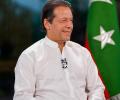
In an interview with the Financial Times following an assassination attempt this month, Khan said he no longer 'blamed' the US and wants a 'dignified' relationship if re-elected.
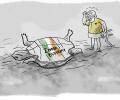
S&P Global Ratings on Monday cut India's economic growth forecast for current fiscal year to 7 per cent, but said the domestic demand-led economy will be less impacted by the global slowdown. S&P had in September projected the Indian economy to grow 7.3 per cent in 2022-23 and 6.5 per cent in next fiscal year (2023-24). "The global slowdown will have less impact on domestic demand-led economies such as India... India's output will expand 7 per cent in fiscal year 2022-2023 and 6 per cent in next fiscal year," S&P Global Ratings Asia-Pacific chief economist Louis Kuijs said.

The 30-share Sensex ended 271 points higher to end at 28,930 and the 50-share Nifty climbed 76 points to close at 8,776.

Projecting over seven per cent economic growth in Asia this year, the International Monetary Fund on Wednesday said countries in the region will be able to exit stimulus measures earlier than the advanced economies.

Major General S C N Jatar, who passed into the ages on Monday night, thwarted anti-national forces at the peak of the Assam agitation. Colonel Anil A Athale (retd) salutes this officer and gentleman.
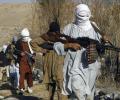
Pakistan has been on the grey list of the Paris-based Financial Action Task Force since June 2018 for failing to check money laundering, leading to terror financing, and was given a plan of action to complete it by October 2019.
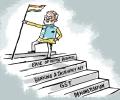
India's GDP expanded 13.5 per cent in the April-June quarter, the quickest pace in a year, to retain the world's fastest growing economy tag but rising interest costs and the looming threat of a recession in major world economies could slow the momentum in the coming quarters.

Significantly, for the first time, the FATF put Myanmar in the "high risk jurisdictions subject to a call for action", often referred to as the watchdog's black list.

Pakistan was put in the inglorious list in 2018 for its failure to check risk of money laundering, leading to corruption and terror financing.
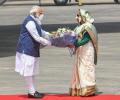
Bangladesh Prime Minister Sheikh Hasina is expected to travel to India on September 5 on a three-day official visit during which defence cooperation and regional stability are likely to be the focus of her talks with Indian counterpart Narendra Modi, an official said on Monday.

The Yuan Wang 5 can easily monitor the Indian coast while operating in international waters. She does not have to enter a port in Sri Lanka to fulfill this mission, points out Commodore Venugopal Menon (retd).

Buoyed by an increase in public investment and incentives to boost manufacturing, India's economy is expected to grow by 8.3 per cent in the fiscal year 2021-22, less than the previous projection early this year before the country was hit by the second wave of the COVID-19 pandemic, the World Bank has said in its latest report. World Bank chief economist for the South Asia Region Hans Timmer told PTI here that when one looks at the high frequency data, they see that as a result of the second wave of the COVID-19 pandemic, the recovery paused, and some indicate that the recovery actually declined briefly. "We project for this fiscal year 8.3 per cent (growth rate for Indian economy) that is less than we projected early in the year before the health crisis caused by the second wave. "Given the sharp contraction of the economy last year, it might not look like a lot, but in my view, that is actually very positive news, given the violent second wave and the severity of the health crisis," he said on Thursday.

Bangladesh might overtake India this year by per capita income in nominal dollars, but it is not yet close to becoming South Asia's economic powerhouse anytime soon, T N Ninan points out.
